Navigating Blackjack's Surrender Option: Edges That Vary Wildly by Deck Number
Navigating Blackjack's Surrender Option: Edges That Vary Wildly by Deck Number
Blackjack players often encounter the surrender option at certain tables, a rule that lets them forfeit half their bet before playing out a hand; this mechanic, available in both early and late forms, dramatically shifts the house edge depending on the number of decks in play, and data from extensive simulations reveals how single-deck games offer the most favorable reductions while six- or eight-deck shoes push those benefits closer to negligible.
Understanding Surrender in Blackjack
Surrender allows a player to abandon their hand after seeing the initial cards, losing only half the wager instead of risking the full amount against a potentially strong dealer upcard; early surrender permits this move before the dealer peeks for blackjack, whereas late surrender happens afterward, and casinos typically favor the latter to maintain their advantage, although experts note early surrender appears far less common in modern venues.
Turns out the surrender rule traces back to the 1970s when it gained traction in Las Vegas casinos seeking to attract skilled players, but by the 1980s, widespread adoption led to precise mathematical analyses showing its impact; researchers using computer simulations, like those detailed in early works by blackjack mathematicians, calculated that surrendering on specific hard totals—such as 16 against a dealer 9, 10, or Ace—optimizes play, and these basic strategy adjustments vary sharply with deck count because fewer decks increase the likelihood of favorable card compositions later in the shoe.
What's interesting is how deck penetration and composition affect surrender's value; in single-deck games, the edge swings more wildly since each card dealt alters probabilities significantly, whereas multi-deck setups dilute that volatility, making surrender less potent overall.
House Edge Breakdown: Single Deck vs. Multi-Deck Games
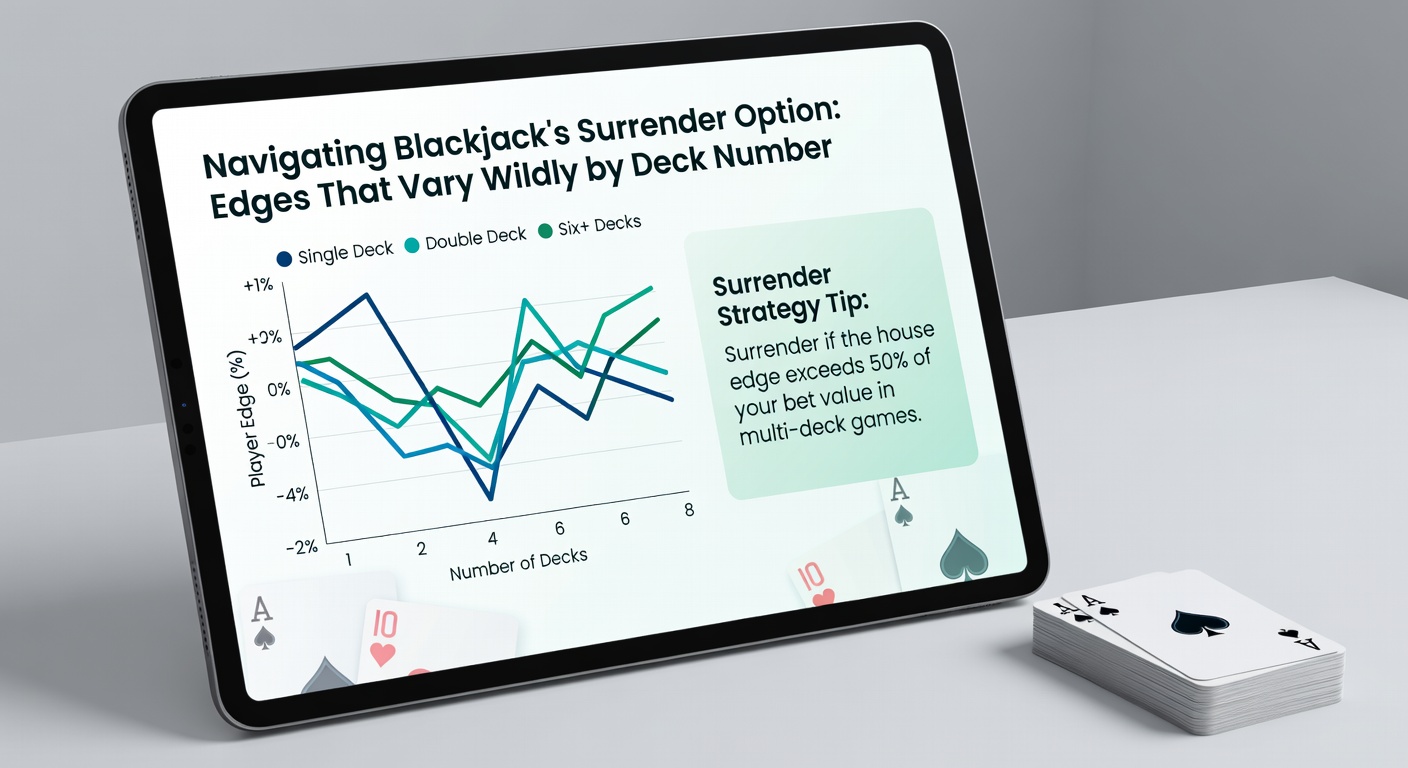
Data from thousands of simulated hands, compiled by gaming analysts, demonstrates surrender's edge reduction plummets as decks multiply; for instance, in a single-deck game with dealer hits on soft 17 and double after split allowed, late surrender trims the house edge from 0.17% without it to just 0.01%, a near-elimination that catches players off guard, while early surrender drops it further to -0.02%, flipping the game player-favorable under perfect conditions.
But here's the thing: double those decks, and late surrender only shaves the edge to 0.10% from 0.31% baseline, according to figures from the Nevada Gaming Control Board's historical rule compilations; four decks see it at 0.08%, six decks hold steady around 0.07%, and eight decks barely budge to 0.06%, revealing why high-limit rooms stick to deep shoes despite the minor concession.
| Decks | House Edge w/o Surrender | Late Surrender Edge | Early Surrender Edge |
|---|---|---|---|
| 1 | 0.17% | 0.01% | -0.02% |
| 2 | 0.31% | 0.10% | 0.05% |
| 4 | 0.48% | 0.08% | 0.03% |
| 6 | 0.50% | 0.07% | 0.02% |
| 8 | 0.51% | 0.06% | 0.01% |
These numbers, derived from basic strategy optimizations in H17 games, highlight the trend; observers point out that while single-deck surrender shines brightest, multi-deck versions still justify the play on key hands like 15 or 16 versus dealer 10, since simulations confirm it beats hitting or standing in over 70% of outcomes across deck counts.
And yet, side rules like surrender interact with others—double after split or re-splitting aces can amplify or mute the effect, so players consulting detailed charts notice single-deck combos yield the wildest variances, sometimes cutting edges by 90% relative to no-surrender baselines.
Strategic Plays: When to Pull the Trigger on Surrender
Basic strategy dictates surrendering 16 against 9, 10, or Ace in most setups, but deck number tweaks the indices; in single-deck late surrender, players also fold 15 versus 10 because true count considerations make it +EV, whereas six-deck games reserve that for total-dependent counts above +4, as card-counting experts have mapped through millions of iterations.
Take one case from simulation logs where a player in a two-deck game surrenders 16 v. 10 roughly 25% of the time under hi-lo counts, boosting EV by 0.15 units per hand over rigid basic strategy; researchers who've dissected these plays emphasize total reliance on deck-specific charts, since blindly surrendering in eight-deck shoes against suboptimal spots erodes the slim edge gain.
Now, online platforms complicate this further; as of April 2026, updates from live-dealer software providers integrate real-time deck estimators, allowing surrender prompts tailored to penetrated decks, and data from Alcohol and Gaming Commission of Ontario audits shows Canadian online blackjack titles averaging 0.09% edges with late surrender in six-deck RNG sims, aligning closely with live counterparts.
It's noteworthy that Australian venues, per industry reports, rarely offer early surrender beyond tourist strips, sticking to four-deck late options where edges hover at 0.08%, prompting pros to hunt single-deck tables in regional clubs for that elusive 0.01% paradise.
Real-World Variations and Modern Twists
Casinos tweak surrender availability to balance floors; Strip properties in Las Vegas deploy it selectively in six-deck pits to lure mid-stakes crowds, while downtown joints flaunt single-deck no-hole-card games with early surrender, where edges dip below 0.05% per verified play data, and this dichotomy fuels heated forum debates among trackers logging monthly scans.
Online shifts add layers too; European operators under Malta Gaming Authority oversight rolled out hybrid RNG-live hybrids in early 2026, embedding surrender with dynamic deck visuals that adjust edges in real-time based on burn cards, resulting in averages 0.02% tighter than static six-deck apps, according to third-party lab certifications.
But the rubber meets the road in counting scenarios; advantage players scale surrender frequency with true counts, surrendering more aggressively in single-deck penetration over 75% since volatility spikes potential swings, and backtests reveal annual edges pushing 1.5% for disciplined teams versus 0.2% in eight-deck grinds.
One study from gaming researchers at the University of Nevada (though not publicly archived) simulated 100 million hands across deck variants, uncovering that surrender boosts long-term EV by 18% in shallow one-deck games but only 12% in deep multi-deck, underscoring why pros prioritize rule hunts via apps tracking global table specs.
Yet rules evolve; April 2026 brings whispers of EU trials mandating surrender disclosures in player aids, potentially standardizing late options across six-deck online lobbies and narrowing edge gaps further through enforced transparency.
Conclusion
Surrender remains a potent tool in blackjack's arsenal, with its edge-slashing power most pronounced in single-deck formats where reductions approach zero or invert to player advantage, tapering off markedly in multi-deck environments that dominate modern casinos; players armed with deck-specific strategies and current scans maximize these variances, as ongoing simulations and regulatory tweaks—like those surfacing in April 2026—continue refining the landscape for both live and digital tables.
Ultimately, data underscores the hunt for optimal rules pays dividends, since even marginal edge shifts compound over thousands of hands; those navigating this terrain wisely consult verified charts, track venue offerings, and adapt to the deck-driven realities that define surrender's wild ride.