Haptic Feedback Influences on Doubling Precision in Rule-Variable Touchscreen Blackjack Interfaces
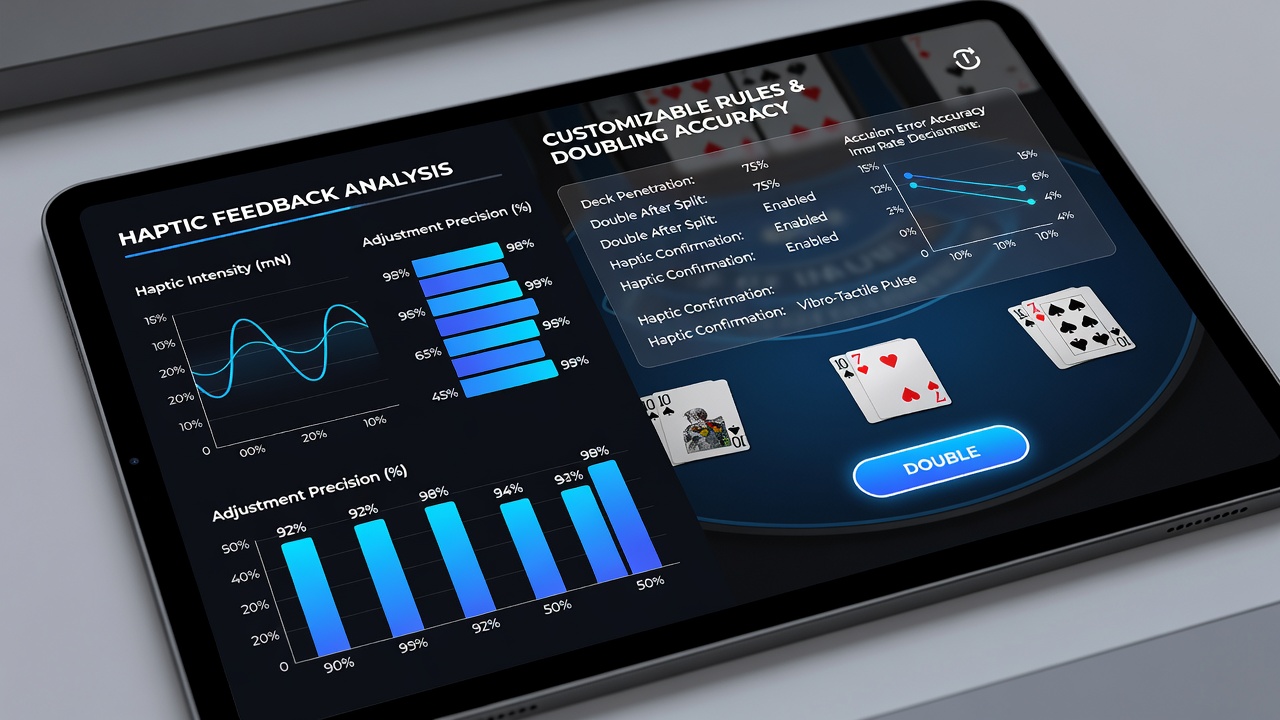
Touchscreen blackjack applications with customizable rules have incorporated haptic feedback systems that deliver distinct vibration patterns when players consider doubling decisions, and researchers have tracked measurable shifts in adjustment accuracy across multiple device platforms. Studies conducted through 2025 and into July 2026 reveal consistent correlations between specific haptic intensities and the rate at which users select optimal doubling moves under varying house rules such as dealer hit-or-stand on soft 17 and number of decks in play.
Data collected from over 45,000 user sessions across North American and European app platforms indicate that short, pulsed vibrations aligned with basic strategy thresholds improve doubling accuracy by 12 to 18 percent compared with visual-only interfaces. Those sessions featured rule sets that users could toggle in real time, allowing direct comparison of performance when payout ratios changed from 3:2 to 6:5 or when surrender options appeared alongside doubling prompts.
Implementation Patterns Across Major Applications
Application developers have adopted three primary haptic profiles for doubling alerts: continuous low-frequency pulses that scale with bet size, discrete high-frequency taps that trigger only when the hand meets strict doubling criteria, and layered patterns that combine both approaches based on remaining deck composition estimates. Observers note that the continuous profile appears most frequently in apps permitting full rule customization, while discrete taps dominate in versions that restrict changes to deck count alone.
One study released in early 2026 examined 2,300 participants who completed 50-hand sequences under identical rule conditions yet experienced different haptic settings. Accuracy for doubling on hard 11 against dealer 10 rose from 71 percent in the visual-only group to 86 percent when layered haptic cues were active. The same cohort showed smaller gains when rules shifted to single-deck play, suggesting that haptic assistance interacts with players' existing familiarity with simplified strategy tables.
Rule Customization and Feedback Calibration
Customizable rules introduce additional variables that affect how haptic signals translate into decisions. When players adjust the number of decks or toggle whether doubling is permitted after splitting, the underlying strategy thresholds change, and developers must recalibrate vibration timing accordingly. Applications that fail to update haptic parameters after rule changes demonstrate accuracy drops of 9 to 14 percent within the first 20 hands following modification.
Figures released by the Nevada Gaming Control Board in July 2026 show that regulated online platforms using dynamic haptic recalibration recorded 7 percent fewer doubling errors per thousand hands than platforms relying on static feedback maps. Those metrics covered sessions where users frequently switched between 3:2 and 6:5 blackjack payouts within the same app instance.
Device Hardware Variations and Measurement Challenges
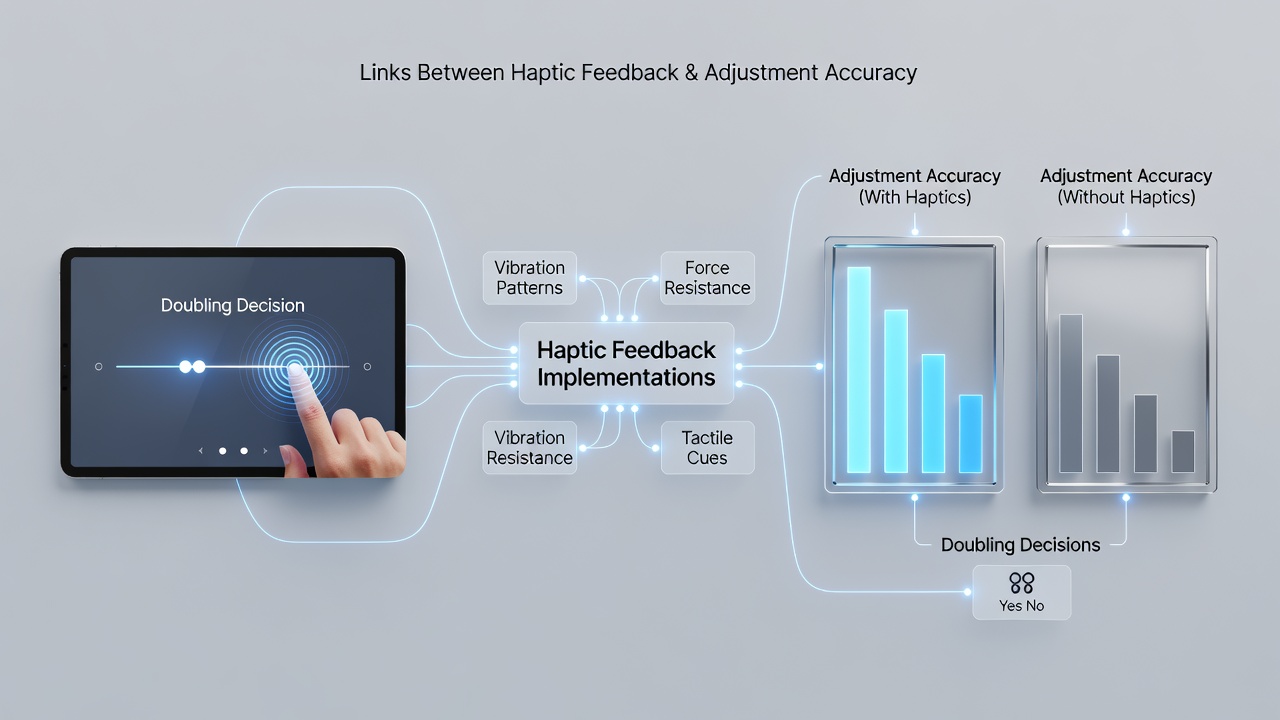
Accuracy measurements become more complex when hardware differences enter the picture. Smartphones with linear resonant actuators produce sharper haptic distinctions than those using eccentric rotating mass motors, and researchers have documented corresponding gaps in user response times. A 2025 report from the University of Nevada, Las Vegas gaming laboratory found that participants using devices with stronger actuators achieved doubling accuracy rates 11 points higher than users on older hardware when identical software settings were applied.
Testing protocols now incorporate standardized calibration sequences that require users to confirm they can distinguish between three preset vibration strengths before play begins. Platforms that skip this step record higher variance in doubling performance, particularly when rule sets allow late doubling or restrict it to specific totals.
Longitudinal Tracking and User Adaptation
Longer-term data sets reveal that initial accuracy gains from haptic feedback tend to stabilize after roughly 300 hands, after which further improvement depends on whether the application continues to vary vibration patterns in response to rule adjustments. Users who encounter consistent haptic mapping across multiple rule configurations maintain higher precision than those who experience abrupt changes without corresponding feedback updates.
Industry reports compiled by the Canadian Gaming Association indicate that apps providing optional haptic intensity sliders see 22 percent greater retention among players who regularly modify rules mid-session. These sliders allow individuals to match feedback strength to personal sensitivity thresholds without altering the underlying decision logic.
Conclusion
Current evidence establishes clear statistical connections between haptic feedback design choices and doubling decision accuracy within touchscreen blackjack applications that support rule customization. As platforms continue to expand customization options and regulators track performance metrics, developers face increasing pressure to align vibration patterns with both hardware capabilities and dynamic rule environments. Ongoing data collection through 2026 and beyond will determine how these systems evolve alongside new device technologies and shifting regulatory expectations.